Thursday, February 25, 2016

If a Benchmark Says You Suck, Change the Benchmark

It is an axiom of sorts that when shit starts hitting the fan, the lounging mandarins aren't just going to sit calmly and get pelted with unseemly shit.  They're going to cover their brandy snifters, fetch ivory-handled umbrellas, and eloquently ponder leaving the room altogether.  Speaking of which, David Yellen is bailing - while Dean Yellen seemed to have more good faith than many of his peers, he'll be working elsewhere while his former students are stuck in the legal world he and his peers built and tried - however hard or feebly - to correct.  It's peculiar, indeed, that academics, whose presence in the legal community may be transient, are seemingly more valued as reformers than attorneys who are in it for life.

The point here, though, is that a real scam is dynamic.  When exposed, an amateur scammer simply folds up shop, disappears, gives up the game.  The second the shit hits, they already have a foot out the door.  But the professional scammer adapts.  He adjusts to his new environs, reacts with subtle modifications and keeps on scamming, pretending that he was never a swindler at all.  A real charlatan, after all, would have folded up and left immediately once that first piece of feces contacted the fan blade.  Instead, a professional scammer sees shit on their arm as a fertilizer for new possibilities.

Consider Arizona Law's recent adoption of the GRE as a potential admissions test.
University of Arizona College of Law’s recent decision to ease up on the LSAT and let prospective students apply with a GRE score, discussed in today’s Wall Street Journal, has caused some consternation in the tightly regimented world of law school admissions.

But to those who wonder, can they do that? Arizona Law Dean Marc Miller has a simple answer: Yes, and other schools can too.
...
Mr. Miller said the school’s proof that the GRE is just as good a predictor of first-year law school grades as the LSAT is a study Arizona Law put together in conjunction with Educational Testing Service, the maker of the GRE. With that study in hand, he said, the school believes it can start taking GRE scores without waiting for a formal blessing from the ABA. Incoming students can still apply using an LSAT score.
I do trust that the study was as scientifically rigorous as, say, the million dollar law degree and the Indiana Tech Feasibility Study.  Obviously, it goes without saying that the study would be peer-reviewed, right?  According to the article, the ABA is preparing an investigation that will presumably involve reading the study and then moving on to more important issues.

For those who are curious about how the study was done, here's the ABA Journal article:
The decision relies on a study finding that performance on the GRE reliably predicted 1L grades for University of Arizona law students. Nearly 100 current and recent graduates of the law school took the GRE in November; the results were compared with their first-year grades.
Given that the band of people who were admitted to Arizona and chose to attend Arizona is far from representative of the applicant population and that a hundred people leaves a large margin of error, it should be fair easy business for the ABA to conclude that it's a perfectly acceptable alternative.

For a few years now, entering LSATs have been slipping.  Law schools at the middle and bottom of the pack have been scrounging for students with LSAT scores that can protect their medians and 25th/75th percentile.  Arizona is no different in that it's either fighting or falling.

But there's an easier way.  Instead of being beholden to the too-small LSAT pool, find some other professional test and use it instead!  And don't worry, Arizona isn't the only experimenter out there.  From the ABA Journal article:
The Wake Forest University School of Law and the University of Hawaii School of Law are both studying how well the GRE measures law school success.
Note that there was never any concern with accepting an alternative test prior to the downturn.  For decades, law school functioned off the LSAT; good, bad, or ugly, it's been fairly reliable.  Suddenly, facing a crisis not only of quantity but quality of students, the law schools innovate.  They find a way to sidestep the benchmark and enter a new world of thought where no one has any idea what GRE scores mean in law school, and won't for some time.

It's astounding how quickly the law schools can act when it is their own best interests to do so.  With respect to tuition and the job market, we've heard lots of hemming and hawing and remarks about institutional inertia and trying to solve the issues and other reasons reform can't exactly happen overnight - or in a five year period.  There have been formal committees whose grand conclusion is to anoint another committee.  And yet, like *that* the law schools are trying to scrap entry credentials that have withstood reasonable criticism for decades.

Not that the LSAT is a great test or anything, but if this was done for any non-cynical reason, it should have been done 20 years ago.  Instead, there are suggestions made like this:
Jeff Thomas, executive director of prelaw programs at Kaplan Test Prep, suggested another benefit in a Wall Street Journal interview. “The GRE is regarded as the easier test,” he said.
It'd be damn impressive were it not so impeaching.

Tuesday, February 16, 2016

Nothing indefinite about the value of a legal education

Thanks to our JD education, we are far more than mere lawyers. "Polished communication" is  among the many marketable "soft skills" that law schools provide to their fortunate students, along with entrepreneurship, leadership, teamwork, cultural competence, and problem solving. This point was eloquently expressed by Nikki Laubenstein, Assistant Dean for Enrollment Management at Syracuse University College of Law.
"In weighing the value of a J.D., you may have already realized that polished communication skills, such as effective writing, speaking, negotiating, and researching are sought after by employers across all platforms. Simply put, the right legal education can equip you with the intellectual and professional skills you need to excel in the legal field and in many other professional arenas. . . . Lawyers are problem solvers and a J.D. gives you the skills to act quickly, accurately, effectively, and with a purpose."
"http://webcache.googleusercontent.com/search?q=cache:-LMBsg9TsxgJ:blog.law.syr.edu/five-reasons-why-students-go-to-law-school+&cd=1&hl=en&ct=clnk&gl=us&client=safari
That, in short, explains why JDs are so advantaged, including those JDs who never take or pass the bar exam or hold a law job. The public views us, their JD-holding heroes, as emergency first responders, uniquely equipped to extinguish conflagrations of intellectual confusion with the speed and purposefulness that the fire department employs against mere physical fires.

Accordingly, law grads, whether from accredited or unaccredited institutions, are especially well suited to address our society's vast unmet need for grammatical services. With access to effective and resourceful legal counsel, no citizen need make an uninformed decision regarding the correct indefinite article for such words or phrases as "purple onion," "big apple," or "egg". Indeed, with additional innovations in legal education made possible by additional billions in high-risk educational loans from the US taxpayer, I am confident that the legal academy can address any lingering deficiency in terms of missing commas.

In the exchange below, a person expresses the rare delusional belief that attending an unaccredited law school is "dumb." She then receives an appropriately stinging rebuke plus salutary correction from someone who identifies himself as a student or graduate of an unaccredited law school. This dispenser of prescriptivist justice flaunts his unaccredited-law-school-honed intellect and puts the critic to shame by articulating the rule on which words get an "a" article and which get an "an" article. Sticklers may notice that he gets the rule wrong, but who can deny that his formulation works in most cases?


[n:  I snagged this exchange over a year ago from a thread on an article about either Concordia or Indiana Tech, but cannot locate the original article.  Ordinarily, I would not publish without a link, but I feel that this instructive exchange should not be lost to history.]

Wednesday, February 10, 2016

If No One Reports, It Didn't Happen: Access Group Sponsors Paper Seemingly Advising Against Many Current Law School Bets

Remember when Simkovic and McIntire published their, uh, landmark research about the million dollar degree (n/k/a "The Economic Value of a Law Degree") during the summer months and it generated quite a bit of online discussion back in the higher-LSAT days of 2013?  Remember when Simkovic himself received a grant from Access Group?

Wouldn't it look somewhat incongruous if Access Group also sponsored a report from an independent economist that indirectly undercuts Simkovic & McIntire's research?

Meet Sandy Baum, who has a PhD in economics from Columbia and studies things like higher education finance and student loan debt.  Unlike Simkovic, she's not a law professor and seemingly has no skin in the "enroll-'em-up!" game.  In December, Ms. Baum published a report for the Access Group Center for Research & Policy Analysis entitled "A Framework for Thinking about Law School Affordability."  Note that the date of publication on SSRN is December 22.

While "Framework" is light on novel solutions (although her analysis of what would make law school a "good" investment is very solid), it gives us a bona fide third-party economics expert who even-handedly analyzed law school affordability.  She wouldn't fit in here or on PrawfsBlawg, and that's a good thing.

And this is some of what she has to say, from the Conclusion section, p. 15-17:
[T]here is no guarantee that even with a positive net present value, the investment in law school will be sufficiently financially rewarding to make the sacrifices involved in paying off the debt most students accrue acceptable.

The variation in law students, in law schools, and in earnings among lawyers makes simple rules about reasonable levels of tuition and debt unrealistic....A young person seeking a career in corporate law who can enroll at Harvard Law School with a scholarship and reasonable expectations for academic success is likely to see a very high rate of return to her investment. A 30 year-old considering enrolling in a lower-tier law school knowing he is geographically constrained to staying in the Midwest should carefully monitor the net tuition he is paying and consider the very real possibility that the investment may not be worth it. His earnings are likely to be below $100,000 a year for his entire career and alternative paths might be more remunerative. Almost certainly, he should not borrow more than $100,000 to finance his education. (emphasis added)
...
Law schools know who their student bodies are and what their career outcomes are likely to be. The hard questions are those facing law schools whose graduates do not have access to the relatively small number of very high paying jobs—those who can expect about the median earnings for lawyers or even less. The reality is that current prices not only lead to debt levels not sustainable at typical earnings levels, but likely generate earnings premiums for many students that do not support the investment.
This isn't revolutionary, particularly for those who have paid honest attention over the last few years, but it is heterodox considering that Access Group - a cabal/civic group of law schools themselves - apparently paid for it and put its stamp on the research.  While the paper is written in a neutral tone, it more or less says that paying significant tuition and living expenses at most private and expensive public non-elite law schools is foolish for most students.  Given the source, it is remarkable to see something so contrary to the rhetoric still being pushed by sub-first-tier administrators.

Moreover, Baum - again, a Columbia economics PhD who studies this stuff regularly - implicitly rolls right over Simkovic & McIntire's research.  She's aware of it - it's cited and discussed on page 10 - but it's impossible to reconcile her general remarks and conclusions with Simkovic & McIntire's.  Her analysis admits a wide and uncertain earnings variance among graduates and the distinct possibility that a law degree "premium" will not justify the investment paid.  Moreover, she admits that even a net positive economic investment may not be worth it from a psychological/emotional standpoint in terms of expectations (see p. 12-13).  At times, it's difficult to not see her trying to impeach Simkovic and McIntire sub silentio by being thoroughly reasonable:
The complexity of evaluating the “affordability” of a law school education is multiplied many times by the extreme variation in prices, job opportunities, and earnings in this market. Knowing that on average, a law degree pays off means little for those for whom the payoff is below average, including the significant portion of graduates for whom it is far below average.
"Framework," p. 13.  Again, this is coming from Access Group - the same organization that allegedly paid Simkovic a six-figure grant.

A naive person might think that such a paper would get as much - if not more - press play than Simkovic and McIntire's" Economic Value."  Yet Baum's paper barely made a whisper in legal discussion circles, possibly because it was released during the holidays, and possibly because legal academics would rather not republish things like "[one] should not borrow more than $100,000 to finance his [legal] education" when it comes from an Access Group-sponsored paper.

All I know is that TaxProf Blog reported it on January 11.  I can't find much else from the usual circles.  Maybe law professors, grand philosophic quests for reason and justice aside, are more like rabid television viewers than they wish to admit, and fall for million-dollar scholarbait but can't be bothered official reports written in an objective tone.

The bottom line is that we have a report from Access Group's retained independent consultant that basically says it's likely a bad idea for most law students to enroll under present conditions, it undermines certain law school propaganda pieces, and it was published during the winter holidays and barely reported.  I'm no conspiracy theorist, but I'm also not a dumbass.

Wednesday, February 3, 2016

Law professor hypocrites campaign against paid externships

The ABA Section on Legal Education is again considering lifting its ban on paid law school externships (ABA Interpretation 305-3). The feedback from law professors and from law professor groups such as SALT has been overwhelmingly negative, with one score-keeping professor stating a couple of years ago that he counted 7 law professors in favor of abolishing the rule and 159 law professors opposed. [1]

The main objection to abolishing the rule is that legal employers who pay students would be less inclined to defer to the exacting standards devised by law professors, thereby disrupting the educational experience and maybe even undermining students’ high ideals of public service.

It is the case that ABA Standard 305 mandates a series of requirements to ensure vigorous law school oversight of field placements. But protesting law professors assert that Standard 305 would not effectively ensure the educational quality of employer-paid field placements, what with mercenary law firm supervisors incentivized to extract value from compensated labor in lieu of mentoring young legal fledglings in their learning process. 

Consider the following quotes from written comments or testimony in opposition to abolishing the paid externship ban:

* "Why are we now driving students, quite frankly, out of those public interest opportunities and into more paid positions?  I think that’s wrong.  I think that’s wrong.  I think this is about education. It is not about making money." -- Bob Kuehn, Associate Dean for Clinical Education, Washington Univ. at St. Louis School of Law, ABA Section on Legal Education, Public Hearing re: Amendments to Standards, April 25, 2014, p. 58. 
* "I believe that the opportunity to receive pay would induce students to take paid positions in-house (for example, at Chanel or MTV) rather than enroll in credited positions in our nonprofit-based clinics (for example, the Consumer Rights Field Clinic)." -- Becky Rosenfeld, Director of Externships, Cardozo School of Law,  Comment to ABA, April 18, 2014.
* "Ultimately, the goals and objectives of paid employment and those of education are often in conflict. Among the goals of legal education are to instill the value of service to society and the obligation of lawyers to contribute. Paying law students to obtain their own education seems at odds with this principle."  -- Prof. Margaret Moore Jackson, University of North Dakota School of Law, Comment to ABA,  April 16, 2014.
* "There is no way to overstate this issue: employers are busy and are not in the role of providing legal education. I have seen students come away from paid internships with distorted ideas of ethics and no sense for why they are have been taught to proceed a certain way in particular job tasks.. .. I think revoking this rule will end up with a larger percentage of unhappy new lawyers who leave the field due to lack of mentorship when they could have instead been directed to a legal field more in keeping with their particular gifts." -- Clinical Prof. Yvonne Troya, University of California-Hastings College of Law, Comment to ABA, April 18, 2014.  
* "If some schools allow students to be paid, schools that refuse to do so will be at a disadvantage at a time of fierce competition for students. Students will more readily see the loss to their pocketbooks from being denied the option of payment than the loss to their educational experience from being paid." -- Society of American Law Teachers (SALT), Letter to the Council Chair of the ABA Section on Legal Education, July 10, 2015.

Even if these fears are warranted, and I do not think they are, the impact on legal education due to abolition of the no-paid-externship rule will be minimal because so few law students would be effected.  There simply will not be a whole lot of law firms or public sector agencies prepared to offer even minimally compensated externships. Lucrative law school externships at Chanel and MTV will be rarer still, especially for matriculates at no-prestige joints like Cardozo. Hell, law student interns are often said to be a lot more trouble than they are worth even when they are working for free.

What bothers me about the stand taken by all these law professors is its hypocrisy and assumption of virtue. The lawprofs are stalwart defenders of the purity of the educational mission against a proposed reform that might put a few bucks in the pockets of a small number of their own heavily indebted students. But did they similarly defend the noble enterprise of legal education against highly questionable developments and practices that put money in their own pockets?

But for a very few brave and honorable dissenters, law faculty did not protest the dizzying tuition spiral. They did not protest the astonishing decline in admissions standards. They did not protest the accreditation of new bottom-tier law schools. They did not protest the absence of peer review for their matchless scholarship. They did not protest the existence of the unnecessary 3L year. They did not protest filling law faculties with professors who have extremely meager, or even nonexistent, backgrounds in actual legal practice. They did not protest the extension of academic credit to obvious boondoggles such as most study abroad programs or even study-aboard-a-cruise-ship programs. They did not turn down the paid vacations masquerading as academic conferences. Such defects in legal education law professors are happy to overlook, no matter how deleterious the impact or expense to their students.

But where these pampered six-figure-salaried control freaks draw the line is at giving a kid two credit hours towards his or her JD degree to supplement his or her $2,500 employer-paid summer stipend at a public defender office or small firm. Personally, I am more troubled by the fat salaries and perks galore corralled by law professors than I am by the meager stipends that might be paid to a small number of externing law students. 

-------------------
note:

[1] Bob Kuehn, Associate Dean for Clinical Education, Washington Univ. at St. Louis School of Law, ABA Section on Legal Education, Public Hearing re: Amendments to Standards, April 25, 2014, p.  62-63.

Friday, January 29, 2016

Santa Clara Asst. Dean for Career Services Vicki Huebner explains how a visit to her favorite dog groomer gave her insights into obtaining legal employment.

I know that some discontented law students and grads have been heard to whine or growl about useless law school career services professionals. And that is a doggone shame because these canine, I mean canny, career companions can actually offer much food, or puppy chow, for thought.

Take, for instance, Santa Clara University School of Law Assistant Dean for Law Career Services Vicki Huebner’s remarkable September 16, 2015 post on her school’s Career Management blog, entitled "What I Learned About Finding a Job in the Legal Profession from My Dog’s Groomer."
In this post, Dean Huebner explains that the practices of her favorite dog groomer correspond to the skills or strategies needed to successfully obtain legal employment. Dog grooming and law job hunting are analogous in three crucial regards: (1) being excellent in the substance of one’s work; (2) branding one’s own market niche; and (3) developing one’s professional relationships.

From Huebner’s post: 
  • "What occurred was not only an excellent grooming session for Gabriel [Dean Huebener's prize Shepland Sheepdog], but a lesson for me on how to apply the principles of thinking like a business owner to the job search strategy."
  •  "There is no question that Juan is an excellent groomer. Just in case I had any doubts, Juan took pictures of Gabriel before and after his grooming sessions. . . . The quality of Juan’s work is the foundation for building his book of business and retaining clients. Likewise, legal job seekers need to demonstrate their ability to engage in the practice of law at a high level. Their attention to detail, demonstrated analytical skills, ability to articulate thought, and clear and concise writing is the foundation to be considered for employment opportunities. Law students should actively seek opportunities to enhance their practice related skills. . . "
  •  "Juan's salon was not the grooming environment I was used to. Juan wants to have a high-end dog grooming business. It is clear from the moment you enter his salon that he is branding himself to be that. . . . Similarly, job seekers have to consider whether or not they are communicating a brand which is conducive to the job market they are trying to enter. In other words, do they "look the part" on their cover letters, resumes, and job interviews." 
  •  "Juan, Gabriel, and I have longstanding relationships. . . . Networking is not about asking for things (e.g. contacts, referrals, and a job). It's about building longer lasting relationships."
  •   "Thanks to Juan, Gabriel looks and smells great once again! More important for me, a visit to Juan’s salon reinforced key strategies about how to advance a job search."

You know, one could write a virtually identical post by identifying the general practices of any successful small businessperson, not just the owner of a high-end pet salon. What is more, one could analogize job hunting or practicing law to almost any activity that requires a modicum of organization, skill, or commitment.

Therefore, if a career services dean enjoys some absorbing little hobby, interest, or lifestyle choice, then he or she can use that to articulate or frame his or her career advice. All it takes is sufficient shamelessness plus a facility for artfully embedding trendy business buzzwords in one's bullshit, I mean dogshit, professional counsel.  The kids won't realize until it is too late that they have been scammed, indeed mocked. 

On the other paw, the job placement record of Santa Clara School of Law and Kennel of Justice speaks, or rather barks, for itself. For the Class of 2014, 35.2% of Santa Clara Law grads obtained non-solo full-time law jobs within 10 months of graduation. Now, relative to other law schools, this is not an impressive result– indeed, it is worse than all but 20 of the 203 ABA-accredited schools and worse than all but five of the 21 ABA-accredited schools in California. But who is to say that the remaining 64.8% are not making a JD-Advantage fortune shampooing dogs?  

Tuesday, January 26, 2016

The National Jurist identifies the most influential editorial board in legal education and the threat it poses to "all that we hold dear."


The glossy magazine National Jurist is hardly a reliable source. The articles in the National Jurist, and its almost identically formatted sister publication preLaw Magazine, are boosterish in tone and shallow in substance, often featuring lists of best law schools for this or that, lists which invariably include lower-tier law schools with deplorable job placement rates. By strange coincidence, the magazine is filled to the brim with advertisements for second, third, and fourth tier law schools.   

However, National Jurist's recent article featuring the alleged 25 "Most Influential People in Legal Education" for 2015 mostly gets it right. The article does, mind you, not the list itself, which is topped for the second straight year by Indiana Univ. Law Prof. William Henderson. This gravelly-voiced windbag incoherently blends futurist Richard Susskind's bleak vision of the forthcoming technological obsolescence of many law firms, especially small firms, with enthusiasm for the job creating potential of tech-based startups and legal process outsourcers. Henderson is optimistic about the capacity of law schools to prepare kids for these interdisciplinary jobs of the future via the dubious method of teaching them the "behaviors and attributes of highly successful professionals."

Also on the Top 25 list are 14 law school deans, one law school dean emeritus, three current or past Association of American Law Schools (AALS) Presidents or executive directors, and daffy gossip columnist and social media enthusiast "Peter Aduren," plus Aduren's Access Group-funded Mini-Me. The Top 25 list includes three reformers, all below 10th place. [1]

What I like about the National Jurist article, as opposed to its accompanying list, is that it focuses heavily on the impact of the "particularly scorching" New York Times editorial published on October 24, 2015 ("Law School Debt Crisis"), which criticized law school admissions practices and student debt loads in scamblogger-like terms, even deeming guaranteed federal educational loans, the lifeblood of the legal academy, to be a socially regressive misallocation of resources. ("If fewer federal dollars were streaming into law schools' coffers and more were directed to fund legal services organizations, the legal profession — and the American legal system as a whole — would be better for it").

The National Jurist article provides very brief profiles of some of the bigwigs on its most-influential list, and several of these profiles mention the honoree's appalled reaction to the Times editorial. For instance, Influential Person #6, University of Washington Law Dean Kellye Testy, rebukes the unsophisticated louts of the Times editorial board for undermining the rule of law and "all that we hold dear," notwithstanding two years of patient AALS tutelage:

  • "She felt she had to respond to The Times. . . because, she said, the editorial relied on inaccurate data and it "evinced a far-too-common misunderstanding about the importance of the rule of law for all that we hold dear, including equality, justice, prosperity, and the common good.""
  • "She said AALS has had a dialogue with The Times for the past two years, so she expected a publication of its quality to do better in terms of accuracy and sophistication of argument."
  • ""It can be challenging to make an argument for the importance of law that resonates," she said... "But lawyers also save lives and create a healthy world.""


By repeatedly referencing the New York Times editorial and the reactions it elicited, the National Jurist article left an impression that most of the persons it identified as powerful shapers of legal education at the national level  are, in fact, weak, defensive, and butthurt, just glorified shills reflexively casting their greed and privilege as nobility of purpose. Why was Kellye Testy so rattled by an editorial? I mean, what are a dozen paragraphs of ill-founded criticism when you have equality, justice, prosperity, and the common good on your side, to say nothing of a $375,012 salary, the AALS Presidency, and more influence on legal education than all but five people?

The New York Times editorial, which used Infilaw's Florida Coastal School of Law as its example of law school scamming at its most egregious, linked to and echoed Paul Campos's remarkable Atlantic Monthly piece from September, 2014 ("The Law School Scam"), which also singled out Florida Coastal.  [2], [3] Amusingly, the fearful name of Campos is unmentioned in the National Jurist's "Most Influential" article and list. I think that Voldemort was similarly excluded from mention in the pages of the National Muggle. But the New York Times is the Paper of Record, too big and too establishment to be ignored. 

The encouraging fact is that the most influential people in legal education for 2015 were the members of the New York Times Editorial Board, not a bunch of scamming law school deans.  

-------------------------------
notes:

[1] National Jurist's selection process does not exactly reflect the views of a broad spectrum of stakeholders in legal education. "[I]n creating our list, we sought nominations from the nation's law schools and added our own nominees. We then narrowed the list to 48 and asked every law school dean and one professor from each school to rate them."  

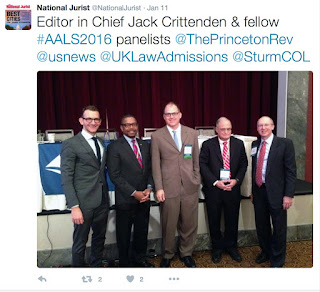
[2] Florida Coastal can console itself that at least it has a friend in Cypress Press, the publisher of both the National Jurist and preLaw Magazine. Jack Crittenden (pictured above), founder of Cypress Press, wrote a puff piece in support of the "plucky" school in the Spring, 2015 edition of preLaw Magazine, entitled "Florida Coastal's Resolve." ("The school received an A+ in preLaw's study on the best schools for practical training, placing eighth overall.  It combines a strong mix of clinics, simulation courses and externships. It recently launched an entrepreneurship clinic. . . "). By strange coincidence, Florida Coastal placed a full-page advertisement on page 2 of the February, 2015 edition of the National Jurist.  

[3]  Florida Coastal may also have a friend in William Henderson, who is on record as praising InfiLaw's approach. In October, 2013, Henderson was quoted in the Wall Street Journal as saying, "InfiLaw is applying a private-equity model to legal education and so far I'm fairly impressed by what I've seen. . . . I think these are people who could  make a difference in legal education."

Thursday, January 21, 2016

White Flight and Charlotte Law

Calling out an Infilaw school is easy.  Heck, even the New York Times recently got in on the fun.  For example, let's take Charlotte Law and look at how terrible the numbers are from a general perspective.

We could point that the LSAT spreads have dropped from 148 and 152 in the 25th and 75th percentile in 2010 to 138 and 146 in 2014 and 140/145 in 2015.  We could observe that the incoming GPAs at the median are now at 2.82, which in non-STEM undergrad is the equivalent of showing up a few times and drooling on the right bubbles on the final exam.

Charlotte's bar pass rates dropped from a pathetic 55% or so on the North Carolina exam for first-time takers in 2014 to a jaw-droppingly pathetic 47.1% in the summer of 2015.  On top of that shit pile, the upstanding dean, Jay Connison, chose to blame the school's recent alumni for choosing to use Themis and just not studying.

We could talk further about the ridiculous price tag for this place, or the school's anemic employment record.

But Charlotte Law has so much more to offer in terms of revulsion:  its somewhat perverted racial dynamics after the admissions bubble turned south.

I'm not one who easily lays down the race card, but Infilaw has opened this can of worms.  Here's Scott DeVito, Florida Coastal dean, in response to the New York Times:
Sometimes it takes a for-profit entity to right a wrong — in this case the lack of diversity in law schools. At Florida Coastal 44.8 percent of the student body are members of minority groups.
And we've previously criticized Connison's (public) views are that LSAT and such shouldn't matter if a law school has other ends, like those that "position themselves to provide opportunity," which is basically an academic euphemism for the exploitation of poor minorities while telling oneself that the shit sandwich being served is part of a balanced, nutritious diet.

Because it's clear if you look at the numbers from Charlotte Law that their decision to enroll minorities is more one of circumstance than of actual organizational purpose.  To wit:


1L CLASS 2011 2012 2013 2014 2015
BLACK 117 193 201 204 174
WHITE 369 366 252 175 128
ALL OTHER 74 100 82 76 52
TOTAL 560 659 535 455 354

JD ALUMS 2011 2012 2013 2014 2015
BLACK 1 27 47 77 122
WHITE 87 190 278 285 266
ALL OTHER 10 17 29 53 62
TOTAL 98 234 354 415 450

Concurrently with law school taking a massive nosedive nationwide and schools moving closer to open admissions, Charlotte Law increased black 1L enrollment dramatically at the same time white enrollment decreased dramatically; proportionately, Charlotte has gone from 66% white/21% black to 49% black/36% white with other being almost a constant.  As a percentage of JDs awarded, blacks went from a little over 1% of the class to over 27% of the class, a number that is likely to increase dramatically as the 2013-2015 1Ls graduate unless the grading curve disproportionately affects black students (but why would it, he asks rhetorically?).

Bar pass rates and incoming LSATs by race and school are not available, but it's really hard not to see a correlation here.  The school dramatically increased black enrollment the same time its admissions doors flung open and its palatable admissions scores started dropping. Much is unknown about why it worked out this way, but it raises some intriguing questions, such as asking if the school is purposely targeting borderline minorities so it can claim it's the school that offers "opportunity."

Taken solely by itself, diversity and racial inclusion are positive goals.  But combined with desperation and predatory admissions policies, the cynicism meter moves off the damned chart.

For example, one could observe that if these individuals - applicants in general with 145 LSATs - are truly fit for legal education and likely to graduate, pass the bar, and enjoy high-income lifestyles, one has to wonder why Charlotte admitted so few minorities back in the halcyon days of 2007-2009 compared to the present, such that the expansion now is noteworthy.

Indeed, one might ask whether Charlotte was being racist then, or if it is instead being racist now?  It's a law school version of "white flight." The rise of so-called "opportunities" prompts the question of why, exactly, those opportunities exist now.  Charlotte Law isn't so much a beneficent source of opportunity newly opened as a post-graduate version of Detroit.

Surely, Charlotte knows that the risk of career catastrophe is very high for its graduates, and no reasonable person could believe otherwise with a straight face.  Charlotte may view itself as a crusader of post-recession racial opportunity, but a simple look at the numbers suggests that this is delusional and completely backwards, an Emperor with no clothes convinced that it's wearing the mantle of diversity.  Charlotte admits these students in exchange for federal loan proceeds knowing full well that the odds of law school completion, bar passage, gainful long-term employment, and loan repayment - not to mention the intangible of career satisfaction - are extremely low (again, if they are not, why did they not admit these same students 5-10 years ago?). 

Absolutely, the prestigious side of the bell curve has a race problem.  The solution is clearly not, however, to cynically admit minorities into a likely dead end so that a corporate enterprise can claim to be seeking justice when someone calls out its avarice and declining standards.

It's one thing to disgustingly exploit 143 LSATs to keep your shitty for-profit operation floating.  Specifically targeting minority 143 LSATs - which it appears Charlotte may be doing as a contemplated strategy in the admissions department; either that, or whites just don't apply, which should, I suppose, also be a red flag - is a brand new level of reprehensibility.  This is particularly so where North Carolina already has a functioning law school, established in the 1930s, directly affiliated with an HBCU that charges lower tuition with similarly weak employment prospects (though, one would assume, a better reputation in the region, particularly for African-Americans).

I would concede that the profession would benefit from having more black practitioners on a relative basis (obviously, on an absolute basis, the profession needs more no one).  However, this isn't the answer.  Disproportionately saddling risky, marginal minority candidates with massive debts unlikely to be repaid to benefit a for-profit enterprise does not advance racial progress in the United States or in the legal profession; quite the opposite.  This isn't paternalism or far-flung speculation.  It's common fucking sense, it's exploitative (intentional or not), and it's wrong.

Of course, as big of a rip off as Charlotte is, be you black, white, or whatever, there are others who manage to be ripped off for far greater sums.